Envocare Projects & Services is one of the leading Zero Liquid Discharge (ZLD) Plant Manufacturers in Maharashtra, delivering advanced and customized wastewater recovery solutions for industries across diverse sectors. With extensive industry experience and a proven engineering approach, we have successfully completed 500+ Water & Wastewater Treatment Projects, supported by a team of 50+ expert engineers and technical professionals, while operating and maintaining 120+ treatment plants for industrial and commercial clients. Trusted by 300+ satisfied clients, we design high-performance ZLD Plants that maximize water recovery, eliminate liquid discharge, ensure environmental compliance, and deliver long-term operational reliability.
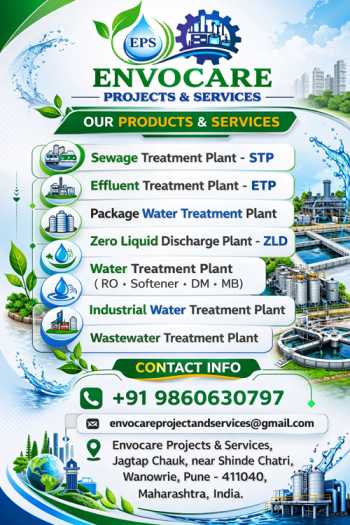
Apart from being a trusted Zero Liquid Discharge Plant Manufacturer in Maharashtra, Envocare Projects & Services is also recognized as one of the leading suppliers, dealers, and service providers of complete water and wastewater treatment solutions. We provide turnkey services including system design, manufacturing, supply, installation, commissioning, operation & maintenance (O&M), plant upgradation, and technical support. Our expertise includes Zero Liquid Discharge (ZLD) Plants, Effluent Treatment Plants (ETP), Sewage Treatment Plants (STP), Water Treatment Plants (WTP), Reverse Osmosis (RO) Plants, Multi Effect Evaporators (MEE), and Mechanical Vapor Recompression (MVR) systems, helping industries achieve maximum water reuse, zero liquid discharge, regulatory compliance, and sustainable water management.
A Zero Liquid Discharge(ZLD) Plant is an advanced industrial wastewater treatment system designed to recover, recycle, and reuse water while eliminating liquid waste discharge. The system combines technologies such as pre-treatment, membrane filtration, Reverse Osmosis (RO), thermal evaporation, and crystallization to separate contaminants, recover high-quality water, and convert the remaining dissolved solids into reusable or safely disposable salts. A ZLD plant helps industries maximize water recovery, reduce freshwater consumption, achieve environmental compliance, and support sustainable water management by ensuring complete zero liquid discharge.
As Zero Liquid Discharge Plant Manufacturers in Maharashtra, we follow a structured multi-stage treatment process that transforms industrial effluent into reusable water while ensuring completes zero liquid discharge.
| Step | Steps of a Zero Liquid Discharge Plant | Description |
|---|---|---|
| 01 | Primary Effluent Collection (Effluent Management Plant) | Wastewater is collected and routed for initial handling and controlled processing. |
| 02 | Pre-Treatment Stage (Filtration & Chemical Treatment) | Suspended solids and impurities are removed for smooth downstream treatment in a Wastewater Purification Plant. |
| 03 | Membrane Filtration Stage (Membrane Filtration System) | Dissolved contaminants are separated to improve overall water quality. |
| 04 | RO Treatment Stage (Reverse Osmosis System) | High-quality water is recovered for safe industrial reuse. |
| 05 | Thermal Evaporation Stage (Thermal Evaporation System) | Remaining wastewater is concentrated into brine using heat-based separation supported by Multi Effect Evaporator technology. |
| 06 | Crystallization & Recovery (Salt Recovery Process) | Final salts are extracted, achieving complete zero liquid discharge. |
As Zero Liquid Discharge Plant Suppliers in Maharashtra, we design and supply multiple ZLD system configurations tailored to industry-specific wastewater characteristics and recovery goals.
| Parameter | Thermal ZLD | Membrane-Based ZLD | RO + Evaporator + Crystallizer ZLD | MEE-Based ZLD | MVR-Based ZLD | Evaporator + Crystallizer ZLD | Solar ZLD / Solar Evaporation |
|---|---|---|---|---|---|---|---|
| Technology | Thermal evaporation + crystallization | UF/NF/RO + high-pressure membrane concentration | RO + evaporation + crystallization | Multiple Effect Evaporation | Mechanical Vapor Recompression | Evaporation + crystallization | Solar evaporation |
| Typical Capacity | 10–2,000+ m³/day | 10–5,000+ m³/day | 20–2,000+ m³/day | 20–2,000+ m³/day | 20–1,500+ m³/day | 10–1,000+ m³/day | 10–10,000+ m³/day |
| Typical Feed TDS | 20,000–150,000+ mg/L | 5,000–80,000 mg/L | 5,000–50,000+ mg/L | 20,000–100,000+ mg/L | 20,000–150,000+ mg/L | 30,000–200,000+ mg/L | 10,000–200,000+ mg/L |
| Primary Process | Evaporation + crystallization | Membrane separation + concentration | RO concentration + thermal treatment | Multi-stage evaporation | Vapor recompression + evaporation | Evaporation + forced crystallization | Natural solar evaporation |
| Operating Mode | Continuous | Continuous | Continuous | Continuous | Continuous | Continuous | Continuous / Seasonal |
| Typical Overall Recovery | 90–99.5% | 70–95%* | 90–99% | 90–99% | 90–99.5% | 90–99.5% | 80–99%+** |
| Typical RO Recovery | Not applicable | 60–85% per stage | 60–85% per stage | Optional | Optional | Not applicable | Not applicable |
| Evaporation Technology | Thermal evaporator | Not normally required in initial stage | MEE / MVR / thermal evaporator | Multiple Effect Evaporator | MVR evaporator | Forced-circulation evaporator | Solar evaporation ponds |
| Typical Number of Effects | 1–7 | Not applicable | 3–7 where MEE is used | 3–7 | 1–3 optimized stages | 1–5 | Not applicable |
| Operating Temperature | 60–110°C | 20–45°C | 60–110°C | 60–110°C | 60–100°C | 70–120°C | Ambient |
| Operating Pressure | Vacuum / Atmospheric | 5–120 bar | 15–80 bar RO + vacuum evaporation | Vacuum | Vacuum | Vacuum | Atmospheric |
| Steam Requirement | Medium–High | Low / None | Medium | 0.15–0.40 t/m³ evaporated | Very Low | Medium–High | Nil |
| Electrical Power Consumption | 15–50 kWh/m³ | 3–20 kWh/m³ | 5–25 kWh/m³ | 10–35 kWh/m³ | 20–40 kWh/m³ | 10–40 kWh/m³ | 0.5–5 kWh/m³ |
| Thermal Energy Requirement | 600–1,200 kWhth/m³ | Low | 300–900 kWhth/m³ | 500–1,000 kWhth/m³ | 50–150 kWhth/m³* | 500–1,200 kWhth/m³ | Solar energy |
| Major Equipment | Evaporator, separator, crystallizer, centrifuge | UF/NF, RO, HPRO, cartridge filters, dosing system | Pretreatment, RO, evaporator, crystallizer, centrifuge | MEE, calandria, separator, condenser, crystallizer | MVR evaporator, compressor, separator, crystallizer | Evaporator, crystallizer, centrifuge, slurry system | Evaporation ponds, liners, pumps, salt collection |
| Pretreatment Requirement | High | Very High | High | High | High | High | Moderate |
| Membrane Requirement | No | Yes | Yes | Optional | Optional | No | No |
| Crystallizer Requirement | Yes | Optional / Final Stage | Yes | Usually Yes | Usually Yes | Yes | No |
| Final Product | Crystallized salts + recovered water | Concentrated brine + recovered water | Crystallized salts + recovered water | Salt slurry/solid + recovered water | Salt slurry/solid + recovered water | Crystallized salts + recovered water | Dried salts + evaporated water |
| Salt Recovery Potential | High | Low–Moderate | High | High | High | Very High | Moderate–High |
| Land Requirement | Low–Moderate | Low | Low–Moderate | Low–Moderate | Low | Low–Moderate | High |
| Capital Investment | High | Moderate–High | High | High | Very High | High | Low–Moderate |
| Operating Cost | High | Moderate | Moderate–High | High | Moderate | High | Low where suitable land is available |
| Maintenance Requirement | High | High | High | High | High | High | Low–Moderate |
| Scaling / Fouling Risk | High | Membrane fouling/scaling | Membrane + evaporator scaling | High | High | Very High | Low mechanical / pond-related risks |
| Automation | PLC/SCADA | PLC/SCADA | PLC/SCADA | PLC/SCADA | PLC/SCADA | PLC/SCADA | Basic to PLC/SCADA |
| Typical MOC | SS316L / Duplex / Special Alloys | FRP / SS304 / SS316L | SS316L / Duplex | SS316L / Duplex | SS316L / Duplex / Titanium | SS316L / Duplex / Special Alloys | HDPE/LLDPE liner + FRP/SS |
| Best Suited For | Very high-TDS industrial effluent | Low-to-medium TDS concentration | General industrial ZLD | High-TDS industrial wastewater | High-TDS wastewater with economical power | Very high-TDS brine and salt recovery | High-solar-radiation sites with sufficient land |
| Typical Industries | Chemical, textile, pharma, fertilizer, API | Textile, pharma, food, chemical, ETP reuse | Textile, chemical, pharma, electroplating | Textile, chemical, pharma, specialty chemicals | Chemical, pharma, textile, high-TDS industries | Chemical, mining, salt recovery, industrial brine | Mining, salt recovery, remote industrial sites |
| Key Advantage | Robust final ZLD treatment | Reduces thermal load | Balanced membrane + thermal configuration | Proven multi-effect technology | Low steam consumption | Excellent salt recovery | Very low external thermal energy |
| Key Limitation | High energy consumption | Membrane fouling and concentration limitations | Higher system complexity | Steam requirement | Higher electrical load and CAPEX | Scaling and crystallizer maintenance | Large land requirement and climate dependence |
*Note: Indicative engineering ranges only. Actual ZLD performance depends on wastewater characteristics, TDS, COD, hardness, silica, chloride, sulfate, scaling potential, feed temperature, required recovery, salt chemistry, utility conditions and final process design. Energy consumption, water recovery and equipment configuration should be confirmed through detailed mass balance, heat balance and wastewater analysis.
As Zero Liquid Discharge Plant Services in Maharashtra, we engineer ZLD systems with advanced multi-stage treatment, automation, and robust design to ensure high efficiency and long-term industrial reliability.
As Zero Liquid Discharge Plant Service providers in Maharashtra, we enable industries to achieve complete wastewater elimination, reduce operational costs, and support sustainable water conservation and environmental compliance.
As a Zero Liquid Discharge (ZLD) Plant in Maharashtra, we provide advanced industrial wastewater treatment solutions for industries that require efficient water recovery, wastewater recycling, and minimal liquid effluent discharge. Our ZLD systems are suitable for handling high-TDS, high-salinity, and complex industrial wastewater while supporting sustainable water management and reuse through an integrated Wastewater Recycling Plant.
Envocare Projects & Services is a trusted Zero Liquid Discharge Plant Manufacturer in Maharashtra, delivering advanced wastewater recovery and water reuse solutions for industries across diverse sectors. As leading manufacturers, suppliers, dealers, and service providers, we provide complete turnkey solutions including system design, manufacturing, supply, installation, commissioning, operation & maintenance, and plant upgradation. Our advanced ZLD systems are engineered to maximize water recovery, eliminate liquid discharge, reduce operating costs, and ensure compliance with CPCB, SPCB, and environmental standards. Backed by 500+ successfully completed Water & Wastewater Projects, 50+ expert engineers and technical staff, 120+ plants under operation & maintenance, and 300+ satisfied industrial and commercial clients, we deliver reliable, customized, and sustainable Zero Liquid Discharge solutions that support long-term industrial growth and responsible water management. Contact Us today to discuss your Zero Liquid Discharge Plant requirements and receive a customized solution.
A Zero Liquid Discharge Plant is a wastewater treatment system designed to recover and reuse almost all water from industrial effluents. It ensures that no liquid waste is discharged into the environment.
Zero waste discharge means treating wastewater in a way that no liquid effluent is released outside the facility. All water is recovered, reused, or converted into solid waste.
The cost depends on plant capacity, industry type, and treatment technology used. It varies from project to project after proper technical evaluation and customization.
Operating cost depends on energy usage, system design, and maintenance needs. However, water recovery and reuse significantly reduce long-term expenses.
Yes, these systems are specially designed to treat high TDS and complex industrial effluents. Advanced technologies like evaporation and membrane filtration ensure effective treatment.
Envocare Projects & Services provides complete Water & Wastewater Treatment Solutions including STP, ETP, WTP, RO and ZLD systems for industrial and commercial applications across India.
© Envocare Projects & Services. All Rights Reserved.